

Founders Pair Financial Model Templates With AI to Build Investor-Ready Pitch Decks
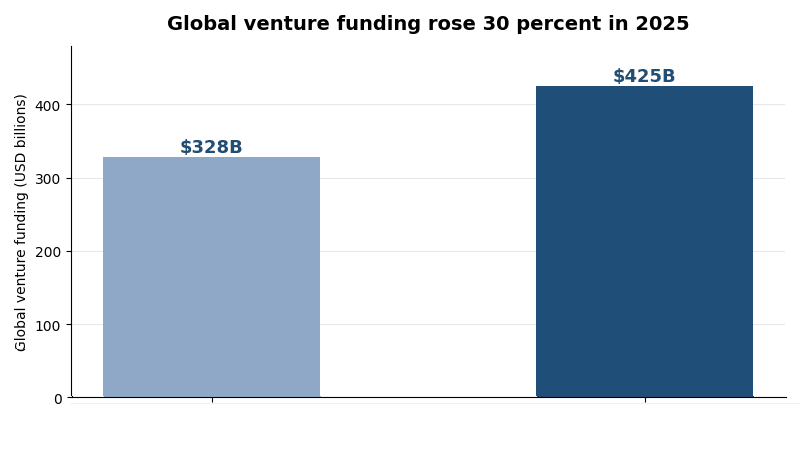
Global venture funding reached $425 billion in 2025, up 30 percent from $328 billion in 2024, according to Crunchbase data.

Venture funding to AI companies reached $211 billion in 2025, up 85 percent from $114 billion in 2024, according to Crunchbase data.
AI tools now turn a finished financial model into slides in a fraction of the former time, making the model the founder's most important fundraising asset.
THE DECK BECAME THE EASY PART
AI presentation tools now generate slide layouts, charts and narrative text directly from a founder's own material, so a deck that once demanded long design cycles can now be drafted quickly. What these tools need to work well is a coherent set of numbers behind the story: the revenue build-up, the cost structure, the hiring plan, the cash runway and the funding requirement. That set of numbers is the financial model, and it has become the real work of fundraising preparation.
"The order of work has flipped in the founder's favor," said a spokesperson for eFinancialModels. "When the financial model comes first, AI handles the presentation layer in a fraction of the old time, and the founder walks into investor meetings with numbers they can defend line by line."
START WITH THE MODEL
Building that model from a blank spreadsheet is the hardest step in the sequence, and it is also the step where a template changes the economics of a founder's time. A professionally built startup business financial model arrives with integrated income statement, balance sheet and cash flow logic, so founders enter assumptions instead of engineering formulas. Plans that call for more sophistication, such as cohort-based revenue builds, multiple funding rounds or valuation analysis, are exactly where a prepared template earns its keep.
A MODEL-FIRST WORKFLOW FOR FOUNDERS
Build the Model First. Enter market, pricing, hiring and cost assumptions into the template to produce a complete multi-year forecast.
Read the Outputs Like an Investor. Check runway, break-even timing and the funding requirement early, and adjust assumptions until the plan holds together.
Generate the Deck With AI. Feed the finished forecast into an AI presentation tool and let it draft the slides, keeping the founder's judgment on the message.
Keep Slides and Spreadsheet in Sync. Every figure on a slide should trace back to a model cell, and pitch deck ready financial visuals keep the charts consistent between the two.
Bring the Model to the Meeting. Investors who like a deck ask for the model next, and having it ready keeps the conversation moving.
Each of these steps rests on the same foundation, a working financial model whose assumptions, line items and forecasts a young company can plan against and update as it learns.
Founders preparing an investor round can explore the full library of startup financial model templates on eFinancialModels.
Communications Team eFinancialModels
eFinancialModels
email us here
Visit us on social media:
LinkedIn
Bluesky
Instagram
Facebook
YouTube
TikTok
X
Legal Disclaimer:
EIN Presswire provides this news content "as is" without warranty of any kind. We do not accept any responsibility or liability for the accuracy, content, images, videos, licenses, completeness, legality, or reliability of the information contained in this article. If you have any complaints or copyright issues related to this article, kindly contact the author above.
